

Cart
0
Research & Insights
Botanicals in Protein Powder: What They Are and What to Check
The Swedish Daily Nutrition™ Routine
Amaris Mint® sells protein powders and food supplements. This article provides general nutrition education and discusses our range.
Ginger, turmeric and green tea may appear alongside protein on an ingredient list. But what does “botanical” mean, and what should you check before choosing a blend?
Start with the product’s purpose. If you want a convenient way to add protein to your day, assess its protein content, serving instructions and suitability first. Then look at the botanical ingredients in context.
Their names help describe the formulation. Understanding their preparation and the evidence behind them helps you ask more useful questions.
What are botanicals?
In nutrition, botanicals are ingredients obtained from plants or plant parts. Examples include ginger rhizome, cinnamon bark and green tea leaves. They may be used as dried material or processed preparations.1
“Botanical” describes an ingredient’s origin. It does not, by itself, establish its nutritional contribution or a health benefit.
A useful first question is: which plant, which part and which preparation?
Plant powder versus extract: what is the difference?
| Description | What it usually means | What to check |
|---|---|---|
| Ground plant powder | Dried plant material that has been milled | Plant identity, plant part and amount |
| Plant extract | A preparation made by extracting constituents using a liquid such as water or alcohol | Extraction details, composition and amount |
| Dry extract powder | An extract processed into a dry form | Whether “powder” describes the extract’s physical form |
| Standardised extract | An extract controlled to a stated level of selected constituents or markers | What is measured and what the specification means |
An extract can therefore also be a powder. Replacing “extract” with “powder” does not necessarily make an ingredient description more accurate.
Standardisation concerns consistency of selected constituents. It is not proof of a clinical benefit. Neither a ground powder nor an extract is automatically the better choice.1
Are turmeric and curcumin the same?
No. Turmeric is a plant whose rhizome is used as a spice and in supplements. Curcumin is one of its constituents, within a group called curcuminoids.
Turmeric powder, a turmeric extract and a preparation standardised for curcuminoids describe different materials. They should not be treated as interchangeable.
Research also uses different preparations. NCCIH notes that this variation complicates interpretation of turmeric and curcumin studies.2
Check whether the label lists turmeric powder, turmeric extract or curcumin. These descriptions are not interchangeable.
How do you judge whether research is relevant?
A familiar ingredient name is a starting point for reading research. It is not enough to establish that a commercial blend will produce the same result.
NIH guidance emphasises identifying and characterising the actual material used in natural-product research.3
When assessing a study, ask:
- What was tested? Check the plant species, plant part and preparation.
- How much was used? Compare the study amount with the relevant product serving.
- Who took part? Results in one population may not answer another group’s question.
- What was measured? A laboratory finding is different from a meaningful outcome in people.
- Was the finished blend studied? Research on one ingredient does not directly test a different multi-ingredient formulation.
For example, a trial of a specified extract does not directly test a shake containing an unspecified amount of that plant. This is a reason to interpret evidence carefully, rather than dismissing research or assuming a benefit.
What should you check before daily use?
Keep the checklist short:
Identity and preparation. Look for the botanical name, plant part and form where provided. Ask the manufacturer about an unclear description.
Amounts. Distinguish an individual ingredient amount from the total weight of a mixture. A combined blend figure cannot tell you each component’s contribution.
Directions and suitability. Read the full allergen information, daily serving and precautions. Check whether other supplements repeat the same ingredients.
Professional advice. If you take medicines, have a medical condition, are pregnant or breastfeeding, ask a pharmacist or appropriate healthcare professional before using a botanical-containing supplement. Suitability depends on the botanical’s composition, preparation, amount and the other products you use.4
Do not increase a protein blend’s serving to match an amount used in an ingredient study. That also increases the other ingredients.
For a broader guide to labels and supporting documents, read Ingredient Transparency in Supplements: What to Check.
Where do botanicals fit within BioBoost?
BioBoost Balance+ Protein™ is designed to make daily protein and nutrition simpler.
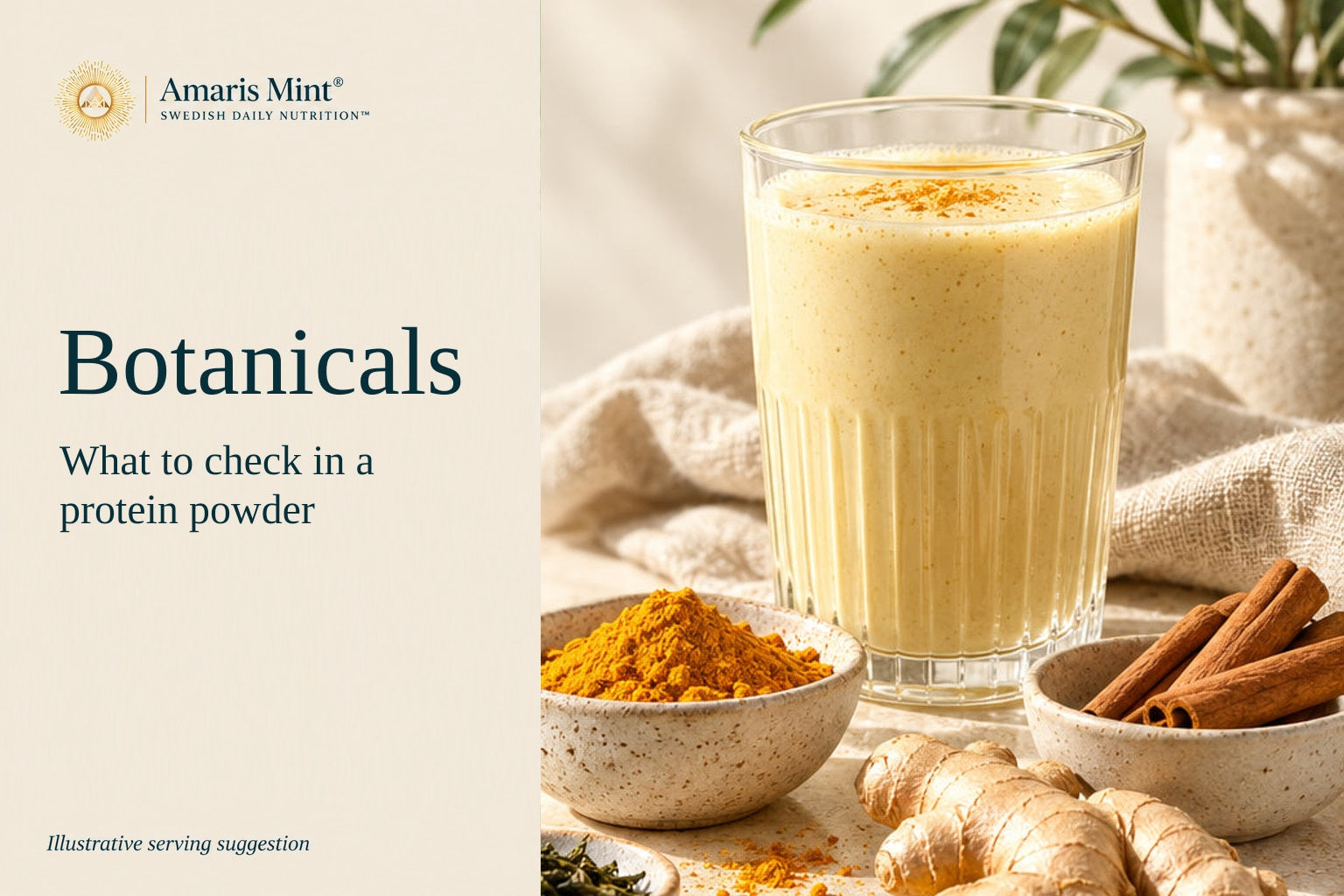
Its wider formulation combines whey protein with hydrolysed collagen peptides, vitamins, minerals and botanical ingredients. The current Vanilla ingredient declaration lists turmeric rhizome extract, cinnamon bark extract, ginger root and instant green tea. These descriptions illustrate why the preparation matters when reading a formulation.
These ingredients should be understood within the complete formulation. Their inclusion does not establish that a serving reproduces the effects of a standalone botanical supplement or a preparation used in research.
Read the current Vanilla ingredients, directions and precautions, and check the information for your specific flavour and pack before use. BioBoost contains milk and bovine collagen and is unsuitable for vegetarians and vegans. Do not use if you are allergic to milk or another listed ingredient.
BioBoost precautions: For adults only. Do not use during pregnancy or breastfeeding, in children, if taking lipid-lowering or hypoglycaemic medicines, or if you have kidney or liver disease. Do not use for prolonged periods without medical advice. If taking other medication or under medical supervision, seek professional advice before use.
Our Quality & Standards page explains the manufacturing and quality information available.
The practical takeaway
Choose a protein powder around a clear daily need. Then assess its botanical ingredients by their identity, preparation, amount and suitability.
A longer ingredient list is not a substitute for that assessment. A useful formulation is one you can understand and use appropriately within your routine.
Daily protein. Nutrition, simplified.
Made in Sweden. BioBoost Balance+ Protein™ is Amaris Mint®’s Daily Nutrition Protein.
References
- NIH Office of Dietary Supplements: Botanical Dietary Supplements Background Information.
- NCCIH: Turmeric—Usefulness and Safety.
- NIH Office of Dietary Supplements: The Importance of Natural Product Characterization and Integrity for Dietary Supplement Research.
- NIH Office of Dietary Supplements: Frequently Asked Questions.
This article is for general education and does not replace individual medical or dietary advice.
