

Cart
0
Research & Insights
Curcumin and Inflammation: What Does the Research Actually Show?
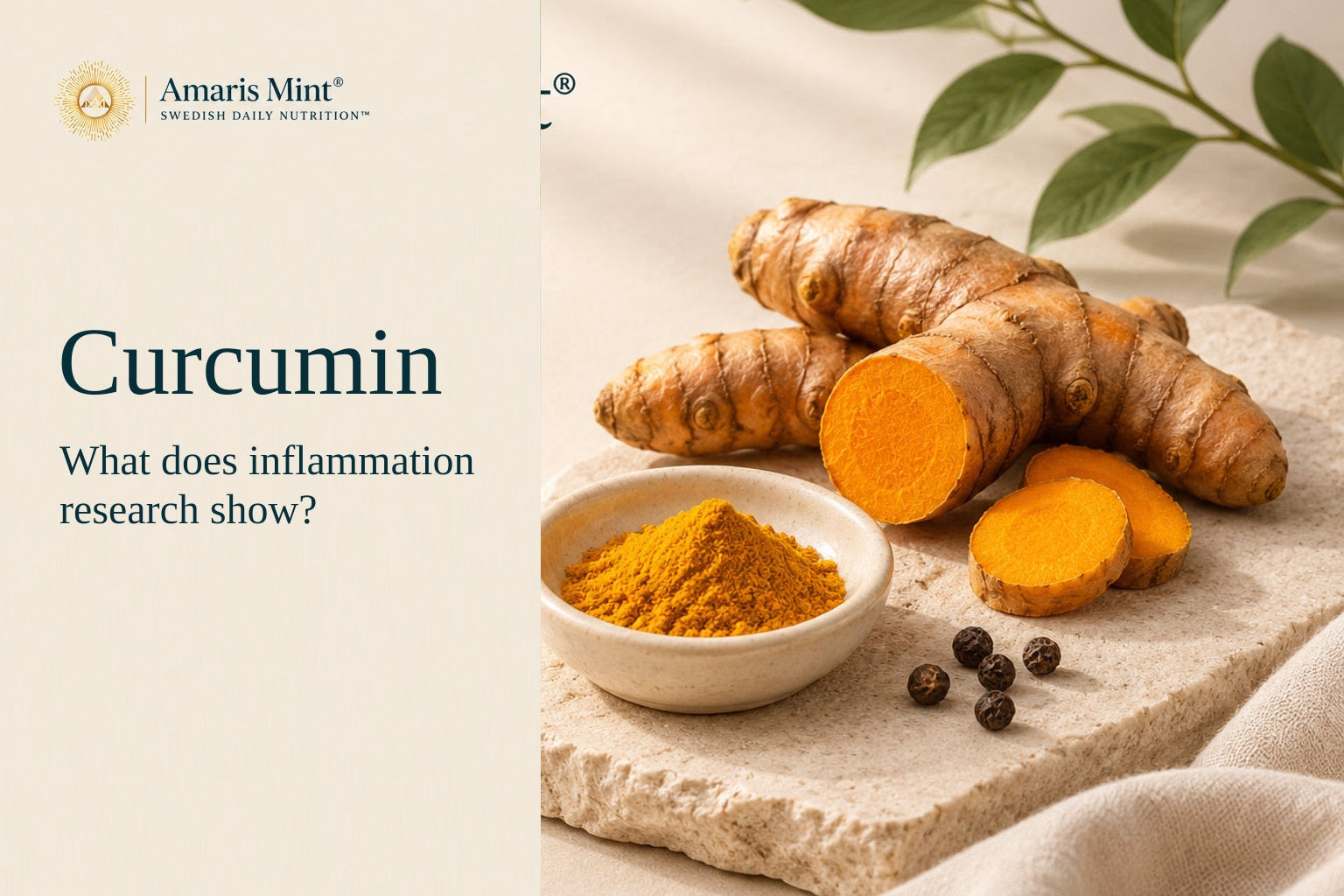
Turmeric is familiar in the kitchen, but understanding the research behind it takes a little more care. Headlines often bring together turmeric, curcumin and inflammation as though every preparation delivers the same results.
Some human studies have found changes in inflammatory markers with particular formulations. The important questions are what was tested, who took it and whether the findings translate into meaningful health benefits.
This article looks at selected human studies and authoritative safety guidance. It is an introduction to the evidence, rather than a comprehensive research review.
What is curcumin?
Curcumin is one of the naturally occurring compounds in turmeric, the golden spice obtained from Curcuma longa. It belongs to a group called curcuminoids.
Turmeric powder and concentrated curcumin extracts are different preparations. Products vary in their curcuminoid content and formulation, so findings from one preparation cannot automatically be applied to another.3
What did the studies actually measure?
One randomised trial enrolled 117 adults with metabolic syndrome, a group of risk factors that can include raised blood pressure, high blood sugar and unhealthy cholesterol levels. Participants received either a curcuminoid preparation or a placebo for eight weeks. The preparation supplied 1,000 mg of curcuminoids and 10 mg of piperine daily.
Researchers found a reduction in C-reactive protein, or CRP, a blood marker associated with inflammation, compared with placebo.
The finding has limits. The study examined a specific preparation in people with a particular health condition. A change in a blood marker does not, by itself, demonstrate that a supplement prevents disease or improves long-term health. These quantities describe the research, not a recommended daily dose.1
In a second trial, 70 adults with knee osteoarthritis took a Curcuma longa extract or a placebo for 12 weeks. The researchers asked participants to mark their knee pain on a 100 mm line. They also used MRI scans to measure the volume of fluid and inflamed tissue around the joint.
On average, the change in pain scores favoured the extract by 9.1 mm. The uncertainty around that estimate was wide. The 95% confidence interval ranged from 0.4 to 17.8 mm in favour of the extract. The scans showed no clear difference between groups. The trial tells us something about how participants felt over those 12 weeks. Whether the extract changed the course of their arthritis remains an open question.2
Why is black pepper often mentioned?
Piperine, a compound found in black pepper, is included in some curcumin preparations to increase bioavailability, meaning how much becomes available to the body.
Greater absorption does not automatically establish a greater health benefit. Safety and the results of studies using that particular formulation still matter. Adding ordinary black pepper to food does not reproduce the measured preparation used in a clinical trial.3
How can you judge a curcumin headline?
Before applying a study’s findings to a product, ask:
- What was studied? Turmeric powder, a concentrated extract or a combination of ingredients?
- Who took part? Healthy adults or people with a diagnosed condition?
- What amount was used? Look for the curcuminoid content, not just the total ingredient weight.
- What changed? A blood marker, symptoms or a longer-term health outcome?
- How long did the study last? Short studies cannot establish lasting benefits or long-term safety.
An ingredient name on a label is the starting point. The preparation, quantity and people studied help determine how relevant the findings are.
What about safety?
Using turmeric as a culinary spice is different from taking concentrated supplements. The UK Committee on Toxicity has identified a risk of liver injury in rare, susceptible individuals taking turmeric or curcumin supplements. Someone may not know beforehand that they are susceptible.4
Turmeric supplements can also cause digestive discomfort. Speak with a pharmacist or clinician before using them if you take medicines, are pregnant or have an existing health condition. Reports of liver injury have included formulations designed to increase absorption.3
Our approach at Amaris Mint®
Amaris Mint® was founded by Dr Nillie Teymouri and Tina M Hirst.
We believe clear information starts with asking better questions: what was tested, in whom, and at what amount? Those details help turn an ingredient headline into something you can understand and assess.
Related reading: Inflammation and Everyday Nutrition: What We Know.
Sources checked: 19 November 2026
References
- Panahi Y, et al. Antioxidant and anti-inflammatory effects of curcuminoid-piperine combination in subjects with metabolic syndrome: A randomized controlled trial and an updated meta-analysis. Clinical Nutrition. 2015;34(6):1101–1108. Read the study.
- Wang Z, et al. Effectiveness of Curcuma longa Extract for the Treatment of Symptoms and Effusion-Synovitis of Knee Osteoarthritis: A Randomized Trial. Annals of Internal Medicine. 2020;173(11):861–869. Read the study.
- National Center for Complementary and Integrative Health. Turmeric: Usefulness and Safety. Read the guidance.
- UK Committee on Toxicity. Statement on the potential risk to human health of turmeric and curcumin supplements: Lay summary. Read the assessment.
