

Cart
0
Research & Insights
FSSC 22000 Explained: What It Means for Supplement Manufacturing
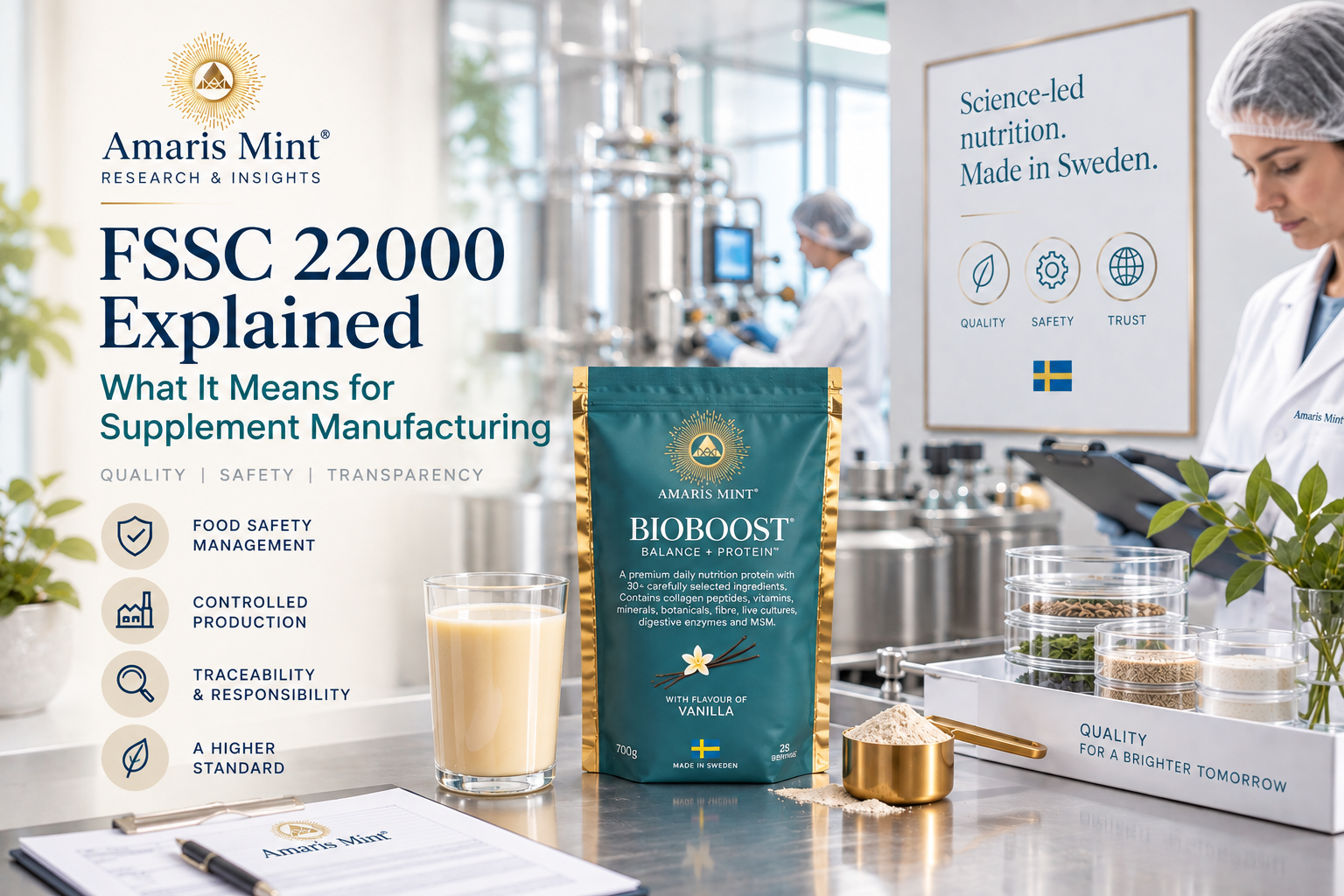
Food-safety certifications can look impressive on a label or website, but the important question is what they actually cover. FSSC 22000 is one of the better-known food-safety management certification schemes used across global food manufacturing. For protein powders and food supplements, it can provide useful evidence about how a manufacturing site manages food-safety risks, documented processes and traceability. It does not certify a product's health benefits.
Reviewed by Amaris Mint® Editorial. Last updated 17 September 2026.
What is FSSC 22000?
FSSC stands for Food Safety System Certification. The FSSC 22000 Scheme is built around ISO 22000, the international standard for food-safety management systems, together with sector-specific prerequisite programmes and additional FSSC requirements.12
ISO 22000 uses a systematic approach to food safety. It incorporates HACCP principles and requires an organisation to identify, assess and control relevant food-safety hazards through a documented management system.2
For a manufacturer, certification is therefore about the management system operating at a defined site and within a defined scope. That distinction matters. A certificate should never be read as a blanket endorsement of every product, ingredient or marketing claim made by a brand.
FSSC 22000 at a glance
| Question | Practical answer |
|---|---|
| What does it assess? | A food-safety management system at a specified organisation, site and certification scope. |
| Is the individual product FSSC 22000-certified? | Not simply because it is made at a certified facility. The certification applies to the organisation and certified scope. |
| Does it prove a supplement or protein powder is clinically effective? | No. Food-safety certification does not establish clinical efficacy or authorise health claims. |
| Does it replace food law? | No. Businesses remain responsible for legal compliance, safe products, labelling and applicable claims requirements. |
| Can a certificate be checked? | Yes. FSSC maintains a public register of certified organisations and advises checking the site, scope, certificate status and certification details.7 |
Why does FSSC 22000 matter in supplement and protein manufacturing?
A protein powder or food supplement can involve multiple raw materials, suppliers, allergens, packaging steps and processing controls. A structured food-safety management system helps the manufacturer define how those risks are identified, controlled, monitored and reviewed.
FSSC 22000 is designed around food-safety management rather than a single end-product test. The scheme combines ISO 22000 with prerequisite programmes for the relevant sector and additional FSSC requirements.1 In practice, that means a buyer should look beyond the certification badge and ask whether the certified scope actually covers the manufacturing activities relevant to the product.
For example, a certificate for a different facility, product category or processing activity is not automatically evidence for another manufacturing site. The exact legal entity, address and scope statement matter.
This is also why we separate manufacturing certification from ingredient and product evidence at Amaris Mint®. They answer different questions.
FSSC 22000, ISO 22000 and HACCP are not the same thing
These terms are often used together, but they are not interchangeable.
| Framework | What it means |
|---|---|
| HACCP | A hazard-analysis approach used to identify food-safety hazards and establish appropriate controls. UK food businesses are generally required to have permanent procedures based on HACCP principles under retained food-hygiene rules.6 |
| ISO 22000 | An international standard specifying requirements for a food-safety management system. It incorporates HACCP principles within a wider management-system framework.2 |
| FSSC 22000 | A certification scheme based on ISO 22000 plus applicable prerequisite-programme requirements and additional FSSC Scheme requirements.1 |
If you want to understand where manufacturing controls sit within the broader production process, read How Is Protein Powder Made?
What changed with FSSC 22000 Version 7 in 2026?
FSSC 22000 Version 7 was officially released on 1 May 2026. The updated Scheme incorporates the new ISO 22002-x:2025 prerequisite-programme series and other changes intended to align with updated food-safety expectations.3
There is a transition period. FSSC states that Version 6 audits may continue until 30 April 2027, with Version 7 upgrade audits taking place from 1 May 2027 until 30 April 2028.3 That means a valid certificate may still reference Version 6 during the transition.
There is an important GFSI detail too. FSSC 22000 Version 6 is currently listed by the Global Food Safety Initiative as a recognised certification programme.4 As of 17 September 2026, Version 7 is going through GFSI's benchmarking process, with a public stakeholder consultation open from 1 September to 1 October 2026.5
So the careful wording today is not simply that every FSSC 22000 Version 7 certificate is already GFSI-recognised. Recognition operates at programme-version level, and Version 7 is still being benchmarked at the time of writing.45
How to verify an FSSC 22000 certificate
If a brand or manufacturer refers to FSSC 22000, check the evidence rather than relying only on a logo. A useful verification process is:
- Check the organisation name. It should match the legal organisation holding the certificate.
- Check the manufacturing address. Certification is site-specific. A certificate for another factory does not automatically cover the site making your product.
- Read the scope statement. It should include the relevant manufacturing activity and product category.
- Check the certificate status and validity dates. A certificate can expire, be suspended or change scope.
- Check the Scheme version. During the current transition, Version 6 and Version 7 need to be understood separately, particularly where GFSI recognition matters.
- Verify it in the FSSC Public Register. FSSC's register is updated regularly and is the appropriate place to check current certified organisations.7
This level of checking is useful for consumers, but it is especially important for retailers, clinics, distributors and other professional partners carrying out supplier due diligence.
What FSSC 22000 does not prove
Food-safety certification is valuable, but it has limits. It does not prove that:
- an ingredient has a particular health benefit;
- a finished product is clinically proven;
- every batch has been tested for every possible contaminant;
- a nutrition or health claim is legally authorised;
- the product is suitable for every person;
- the formula is nutritionally complete.
Those questions require separate evidence. In Great Britain, food supplements are regulated as food, and businesses remain responsible for complying with the relevant safety, composition, labelling and claims rules.8 In the EU, nutrition and health claims are governed separately under Regulation (EC) No 1924/2006 and must meet the applicable conditions of use.9
This is why a quality discussion should combine manufacturing standards with transparent product information. Our guides to ingredient transparency and reading protein powder labels explain the other side of that picture.
What this means for Amaris Mint®
Amaris Mint® products are manufactured in Sweden at an FSSC 22000-certified facility. For BioBoost Balance+ Protein™, this supports our manufacturing and supplier-assurance framework, but we do not present FSSC certification as proof of a health benefit or as independent certification of the finished product.
The role of the certification is narrower and more useful than that: it provides an independently audited framework for food-safety management within the certified manufacturing scope. Product formulation, ingredient evidence, labelling, allergen information and nutrition or health claims still need to stand on their own evidence and legal requirements.
That distinction is part of our approach to Swedish Daily Nutrition™: keep the daily routine simple, while being precise about what the evidence actually means.
If you are comparing products, start with the product's purpose, serving information and label. Then look at how and where it is made. You can explore the Amaris Mint® protein and daily nutrition range alongside our published quality information.
Commercial disclosure: This article is published by Amaris Mint®, which sells nutrition products including BioBoost Balance+ Protein™. Product mentions are included for context and do not change the evidence standards used in this article.
For general information only. This article is not medical advice and is not intended to diagnose, treat, cure or prevent disease. Always read the product label and allergen information before use.
References
- Foundation FSSC. What is FSSC 22000 and why should your organisation get certified? 2026.
- International Organization for Standardization. ISO 22000:2018: Food safety management systems. Current standard page accessed 17 September 2026.
- Foundation FSSC. FSSC 22000 Version 7 FAQ. Version 7 released 1 May 2026; transition timeline published by FSSC.
- Global Food Safety Initiative. GFSI-recognised Certification Programme Owners. FSSC 22000 Version 6 listed as recognised.
- Global Food Safety Initiative. Public stakeholder consultation for FSSC 22000 Version 7. Consultation 1 September to 1 October 2026.
- Food Standards Agency. Introduction to MyHACCP. Guidance on HACCP-based food-safety procedures.
- Foundation FSSC. FSSC Public Register. Register of current certified organisations.
- GOV.UK. Food supplements guidance. Published 25 June 2026.
- European Commission. Nutrition and Health Claims.